
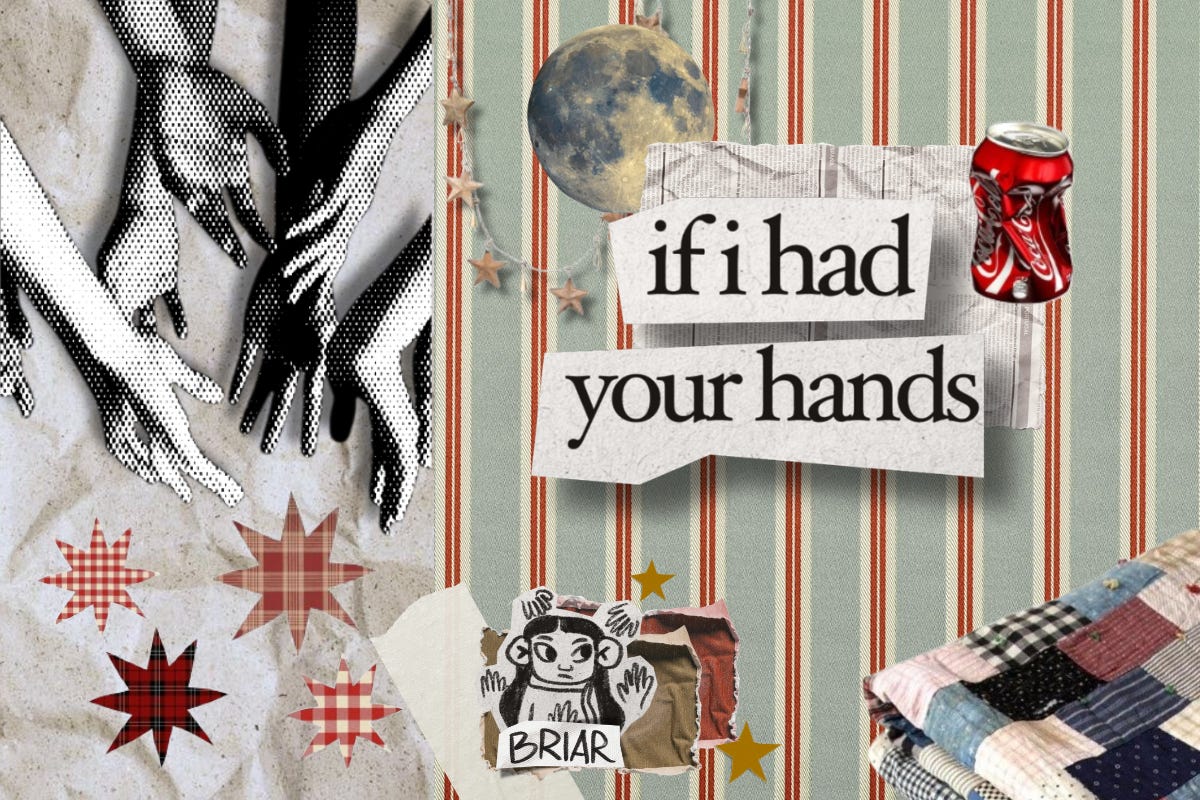
If I Had Your Hands
"I ask God to send a swordsman / and God says ‘look at your hands’" — Melissa Broder

As a child, I could spend hours upon hours watching my siblings draw and play. Through the windows and the dew layered on the glass, I watched as the frost set their boots to slipping and yawns split their flushed faces. And with my chin in my palm, I sat patiently watching Dalia put the pencil to the paper, pausing to shift her attention to the television, and then continuing on.
Participation wasn’t required: I was fully content on the sidelines, my eyes following the movements of their limbs, the precision in their fingers and faces, the fluidity of their shoulders, elbows and knees.
In truth, a deep fascination festered within me. My siblings weren’t particularly interesting, but they represented a normality I lacked (and of which the crevice echoed loudly like the chime of a church bell whenever I attempted to meet them where they were).
I was at the age where the disparities between us deepened with great fanfare. The greatest symbol of this difference?
Dad’s pair of scissors.
It was an afternoon like any other. The top of our granite coffee table was strewn with coloured paper, cartons, glue and pencils. Dalia and Caleb, my siblings, were rowdy and pushy, like they always were, and I silently accompanied them, like I always did.
On this particular day, Dad had given them his sharp, black scissors to borrow. The blades were long and slender and were alight in the brightness of the sun (an architectural choice: have three of four walls in the living room have floor-to-ceiling windows), and he’d pulled this prized possession of his from his desk drawer as he normally never did.
At last, Dalia and Caleb had reached the age where they could wield the blades.
After ceremonially handing the scissors over to my siblings, Dad crouched down next to me, his hand gripping my shoulder for emphasis. “Briar, you can not use these scissors, okay? These are for big kids and adults,” he warned, and then added, “You would get hurt.”
Something flared up within me at that last comment, even as I nodded my head obediently. He mentioned my age, but I didn’t see it as him looking out for me because I was still little. I thought he said it because he noticed the gap between my hands and theirs, just like I did.
This time, when I watched my siblings slip their well-controlled fingers into the scissors, gently guiding the blades over their penciled outlines, I wasn’t okay with just watching.
So when Dalia and Caleb ran into Dad’s office to show him what they’d made, it was only natural that I gravitated to the other side of the table. The bright specks of sun winked and danced in the reflection of the blades, the clear cut lines of its edges beckoning me closer.
Maybe I could prove myself to them. Maybe I could start changing, practicing. Participating.
I pictured the proud smile on Dad’s face, usually reserved for Dalia’s cartwheels and Caleb’s post-dinner singing. I pictured him emerging from his office, seeing the perfect cutout of my drawing, and that exact smile overtaking his look of surprise.
He’d understand why I grabbed the scissors in my pudgy, trembling hands.
The fantasy shattered like glass. I cut into my pinky and yelped, shaken by the scarlet blood that splattered onto the paper and the sting that came immediately after.
Dad, of course, ran out of his office at the sound, Dalia and Caleb hot on his heels. He barked out something about disinfectant and a bandaid to my siblings as he scooped me up and carried me to the kitchen.
I felt embarrassed, in pain and incredulously stupid. This was not how it was supposed to go.
But he wasn’t angry at me, as I thought he might have been. A deep sigh deflated him as he inspected my finger, another as he shook his head. “What did I tell you?”
“Don’t use the scissors,” I mumbled.
“And why did I tell you that?”
My bottom lip quivered. “Because I have stupid hands.”
“No, Briar—” he started, then backtracked— “Well, because of your hands, yes, but also because you’re too small. Look, even Dad cut himself on those scissors just yesterday!” He held up his own hand next to mine, and sure enough, a fresh, crimson cut adorned the side of his empty ring finger.
“But you let Dalia and Caleb use them,” I argued.
Dad sighed. Again. “Because they wouldn’t stop pestering me and promised to be careful,” he said. “That’s a promise they can make, doll. Your hands are not stupid. Nothing about you is. But they’re stubborn and more likely to hurt you. Do you understand?”
I didn’t. Not really. I didn’t understand why, out of everybody in the whole entire world, I was the one who ended up with hands that wanted to hurt me. Why couldn’t I be careful? Why couldn’t I be gentle, precise and controlled? I observed Dalia and Caleb intently: it wasn’t like I didn’t know what it had to look like.
A few years later, in primary school, a friend leaned over our table to watch me draw, and pride swelled within my chest like a balloon. It reminded me of the way I used to watch Dalia, and I wondered if this meant something. My fingers trembled with anticipation, the tightness that came with the realization that I had eyes on me, and I was performing now.
Then, as if she’d been armed with a sharp object just for the occasion, my friend said, “You’d probably be really talented if you were normal!”
Bang. The pride, like a balloon, popped in an instant. I deflated with it.
It was then that I started imagining what I would do if I was. Normal. I’d become an artist, instead of stuffing the drawing into my cubby with hot cheeks. I’d fill notebooks with my own handwriting, and I’d have pretty handwriting, too: swirly, consistent and thin-lined.
I’d kick ass in gym class instead of being the last pick (or no pick). I’d participate in tag during recess, get skates like the popular girls and accompany them as they raced the playground, perfectly balanced. I’d get a drink from one of those paper cups at Starbucks or McDonald’s, and not accidentally squeeze the weak material, spilling the drink everywhere.
Then, when I grew up, I’d get married and slip a ring onto my partner’s finger without so much as a tremble. I’d do presentations, meetings, TV appearances with a mouth that felt like my own. Maybe I’d become a celebrity, praised for my poise and elegance.
I’d grab a pen and roll it in between my fingers. Adorn my ears with the daintiest, tiny little earrings and braid my hair. I’d go out to fancy dinners and gracefully cut into the meat. Drink from a wine glass with my pinky up and get my nails done with my closest girl friends.
But what I imagined most vividly was the day I’d barge into Dad’s office, steady on my feet, and announce: “I need your scissors!”
He’d smile at me. He’d hand them over.
How different would life be? To have normal hands, I imagine, is to define your own limits. To have a normal body is to participate. To have muscles that listen, that relax, that let themselves be steered, is to have watching and observing be a choice, instead of an inevitability.
If I had your hands, I wouldn’t even know where to begin.
Thank you for reading “If I Had Your Hands” 💛 You might also like:
This is so beautiful, I teared up a bit 🥹 how intriguing and honest.
I only have one sibling and wonder how others grow up in a big family, this is lovely to read!